How to Choose a Moroccan Runner Rug for Your Hallway
Choose a runner that leaves a strip of floor visible on each side, about 4 to 5 in (10 to 13 cm), and that stops short of the wall at both ends. Then check that every door along the hallway opens freely over it. In a standard 36 in (91 cm) hallway, that points to a runner between 2 ft and 2 ft 3 in wide (61 to 69 cm).
Here is how to get to the right width, length and construction for your own hallway.
Measure the hallway first
- Width: measure wall to wall at the narrowest point, not the widest. Skirting boards, radiators and door frames all take space.
- Length: measure the full run of floor you want to cover, from one end wall or threshold to the other.
- Doors: note every door that opens into the hallway, and measure the gap between the bottom of each door and the floor.
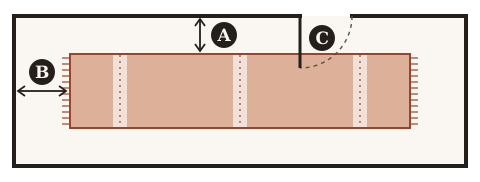
How wide should a hallway runner be?
Guides agree on the principle and differ slightly on the number: leave between 3 and 6 in (8 to 15 cm) of floor on each side, with 4 to 5 in (10 to 13 cm) quoted most often. Less than that and the runner looks squeezed in. More, and it looks like a strip.
| Hallway width | Runner width | Floor left each side |
|---|---|---|
| 36 in (91 cm) | 2 ft to 2 ft 3 in (61 to 69 cm) | 4.5 to 6 in (11 to 15 cm) |
| 42 in (107 cm) | 2 ft 6 in (76 cm) | 6 in (15 cm) |
| 48 in (122 cm) | 3 ft (91 cm) | 6 in (15 cm) |
Ready-made runners usually come 2 ft, 2 ft 3 in, 2 ft 6 in or 3 ft wide. If your hallway falls between those, a made-to-order width solves it.
How long should it be?
A runner should stop before it reaches the end walls. Advice ranges from about 6 in (15 cm) to 12 in (30 cm) of floor at each end, so treat 6 in as the minimum and leave more in a long hallway.
Two further checks:
- Doorways. Where a room opens onto the hallway, the runner should either pass fully in front of the doorway or stop before it. Nobody stepping out of a room should land half on the rug and half off.
- Stairs. Stop the runner well short of the top of a staircase. A rug edge is the last thing you want at the head of the stairs.
Standard lengths run from 6 ft to 14 ft (183 to 427 cm), most often 8, 10 or 12 ft.
Doors, thickness and rug pads
This is where hallway runners go wrong most often. The door must clear the rug and the pad beneath it together. Compare the gap under each door with the combined thickness, and remember that a thick pile compresses under a door but still drags on it.
A rug pad is worth having in a hallway: it stops the runner from creeping and protects the floor. Choose a thin one, made of felt and natural rubber, and cut it about 1 in (2.5 cm) smaller than the runner on every side so that it stays hidden.
Flatweave or pile?
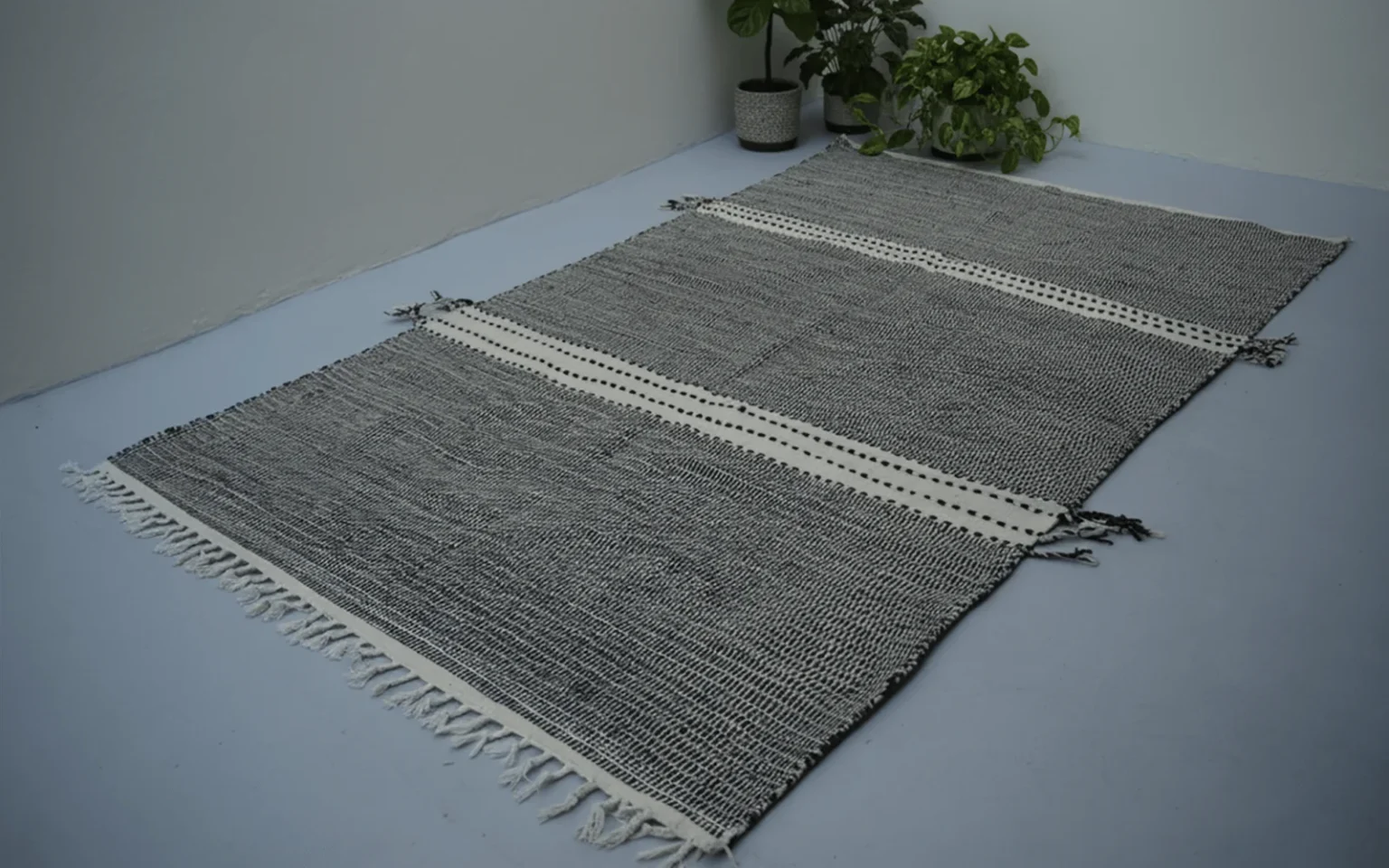
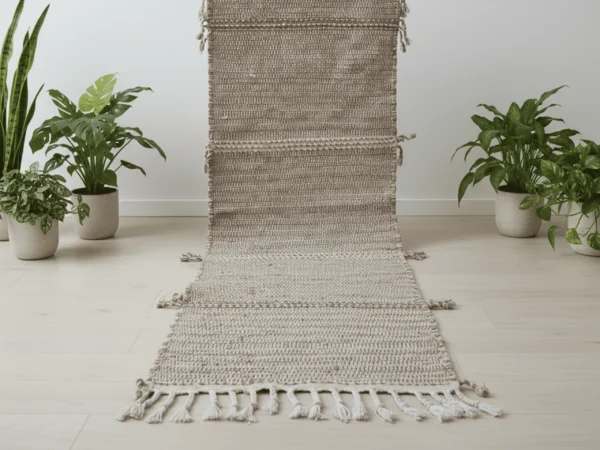
A hallway takes more footsteps per square foot than any room in the house. That favors a flatweave: a rug with no pile, woven flat. It sits low, so doors pass over it and the edge is less of a trip point, and it has no pile to flatten along the walking line.
A pile rug is softer and quieter underfoot. It can work in an upstairs hallway between bedrooms, where traffic is light and no door opens across it.
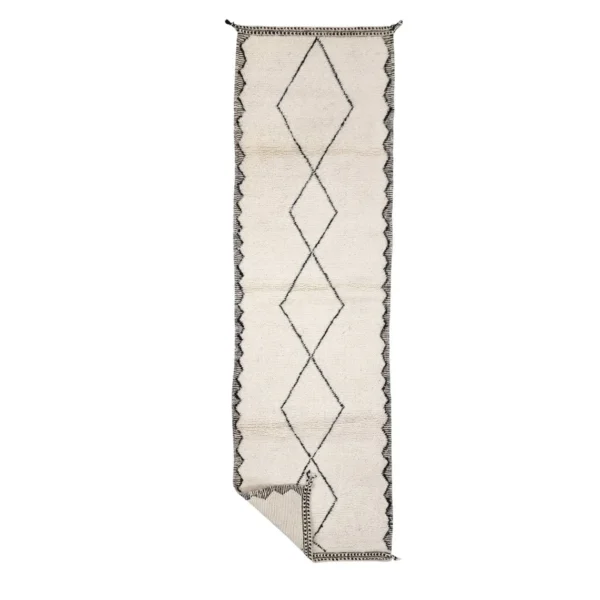
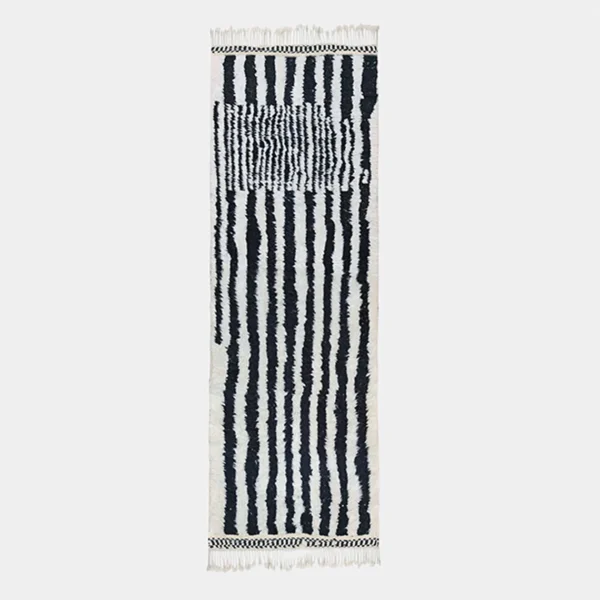
Among Moroccan rugs, Zanafi pieces are flatwoven. Ours is handwoven in 100% wool, and a fine black and ivory texture like this tends to be more forgiving of daily marks than plain pale wool.
Runners, woven to the length of your hallway

Long hallways
Beyond about 16 ft (4.9 m), you have two options. One long runner gives a single unbroken line, and usually has to be made to order. Two shorter runners are easier to handle and to clean. If you use two, keep them identical, line them up exactly, and leave the same gap between them as at the ends.
Ordering a runner in your size
Hallways rarely match standard runner sizes, so our runners are made to order. Open a runner, enter the width and the length you measured, in feet and inches or centimeters, and the page shows the price and the estimated weaving time for that exact size.
\n\n
More runners
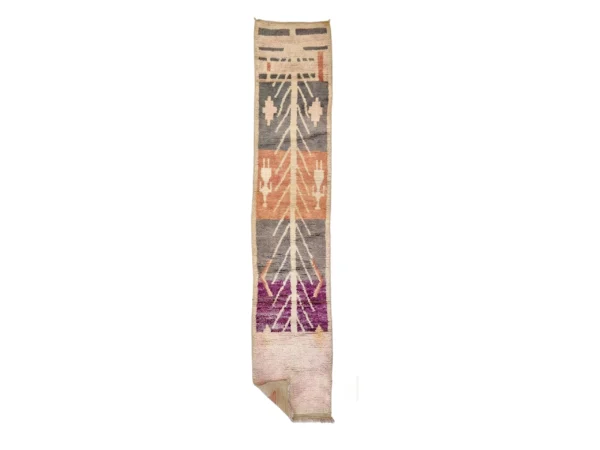

For an unusual space, a very long hallway or a staircase, send us the narrowest width, the full length and the door gaps. We will confirm the right size, the price and the timeline before anything is woven.
Before you order, read what to know about custom and made-to-order rugs. Once the runner is down, our wool rug care guide covers vacuuming and spills.