Moroccan Rug Symbols: What We Know and What Is Myth
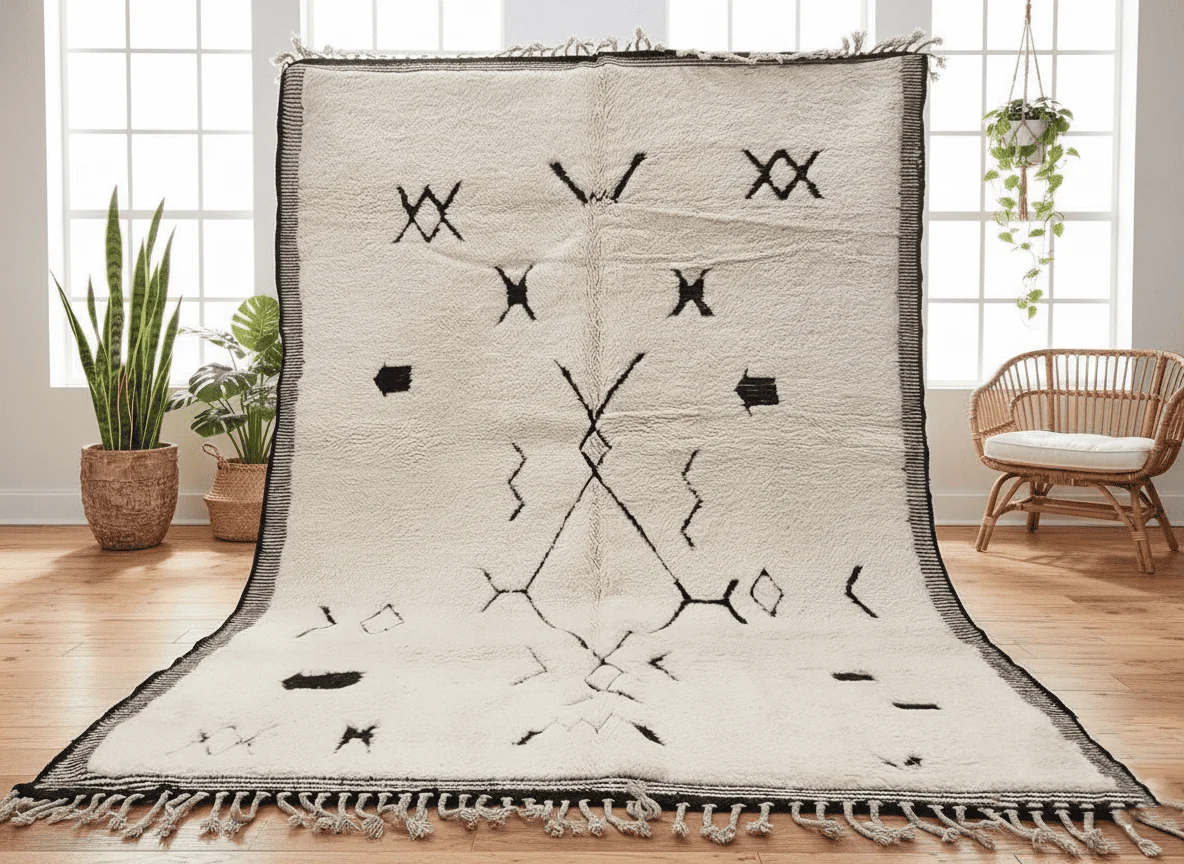
Moroccan pile rugs are full of diamonds, zigzags, crosses, hourglasses and small loose marks, and many shops print a neat list of what each one “means.” The honest answer is shorter. These shapes belong to a wider Amazigh (Berber) visual language that also appears in tattoos, jewelry, doors and pottery. Museums link many of them to protection, especially the eye and the hand. But there is no fixed dictionary. Harvard’s Peabody Museum notes that the names and interpretations of these motifs “may differ from place to place and have changed over time.” A symbol on a rug is a shape with a long history, not a coded message you can translate word for word.
Below: where the shapes come from, what is reasonably well documented, which popular claims have no solid source, and how to choose a rug with symbols for your own home.
Where the shapes come from
In Amazigh communities, weaving has long been women’s work, alongside pottery, henna and tattooing. The 2025 exhibition Amazighes at Mucem, the national museum in Marseille, showed how the same motifs, forms and signs turn up everywhere: on tattooed skin, on jewelry, on household objects, on tent poles and on the walls and doors of houses. A diamond on a rug belongs to the same family of shapes as a diamond in a tattoo or above a doorway.
Some of these geometric shapes have deep roots. The Peabody Museum points out that some motifs have their origins in tifinagh, the ancient Berber alphabet. That is a link of shape and history. It does not mean a rug spells out words, and we found no reliable source showing that weavers write sentences into their rugs.
What is reasonably well documented
- Protection is the strongest thread. Mucem describes Amazigh adornment as tied to a sense of protection and renewal, with motifs that play a protective role as well as marking social identity and gender.
- The eye. The Peabody Museum shows a man’s wool and goat hair cape (akhnif) from the Siroua Mountains in Morocco, woven with eye motifs to protect the wearer from invisible dangers.
- The hand. The hand, often called the khamsa or hand of Fatima, and the eye are both used across North Africa against the evil eye.
- Variety is the rule. Names and readings change from one place to the next and from one generation to the next. The same shape can carry different stories, or simply be a shape the weaver likes.
Popular claims, checked
| What you often read | What we can actually say |
|---|---|
| Every symbol has one fixed meaning | Museum sources say names and meanings vary by place and have changed over time. A single universal list does not exist. |
| The diamond means fertility, the frog means abundance, the comb means womanhood | These lists are common on shop websites but rarely cite a source. Some readings may be local and real. None is universal. |
| A Moroccan rug is a written text you can read | Some motifs come from the tifinagh alphabet, but no reliable source shows rugs being written or read like a sentence. |
| Each color has a set meaning (red for protection, blue for wisdom) | The same caution applies. Color lists differ from one seller to the next and rarely say where they come from. |
| The weaver’s life story is in the rug | A weaver may give her own meaning to a rug, but only she can tell you what it is. Anyone else is guessing. |
Common motifs and where you see them
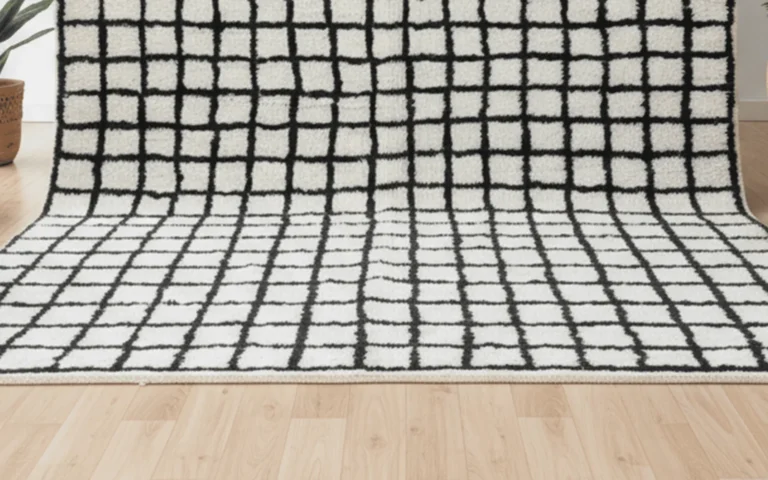
- Diamonds (lozenges). The most common shape in Moroccan rugs, from the open black lattice of a Beni Ourain style rug to the filled, colored diamonds of rugs from the south. Many writers read a diamond as an eye, which fits the protective theme, but it is a reading, not a rule.
- Zigzags and chevrons. Running borders and lines that cross the field. They also appear in tattoos and on pottery.
- Crosses and X shapes. Small crossed marks scattered in the field, often near the corners.
- Hourglasses and triangles. Two triangles point to point, alone or in rows.
- Hands and eyes. The two motifs with the clearest protective role in museum sources.
- Free marks. Little arrows, stars, tents and doorways that do not repeat. These are often the most personal part of a rug.
How we describe symbols at TAZRIRT
On our product pages we describe what is woven: the linked diamonds, the hourglasses, the crossed zigzags, where they sit and how big they are. When a rug follows the look of a style, we say so, without tying it to a tribe or region we cannot confirm. We do not attach meanings we cannot support. If a weaver tells us what a motif means to her, that is something we can pass on. A meaning copied from a list is not.
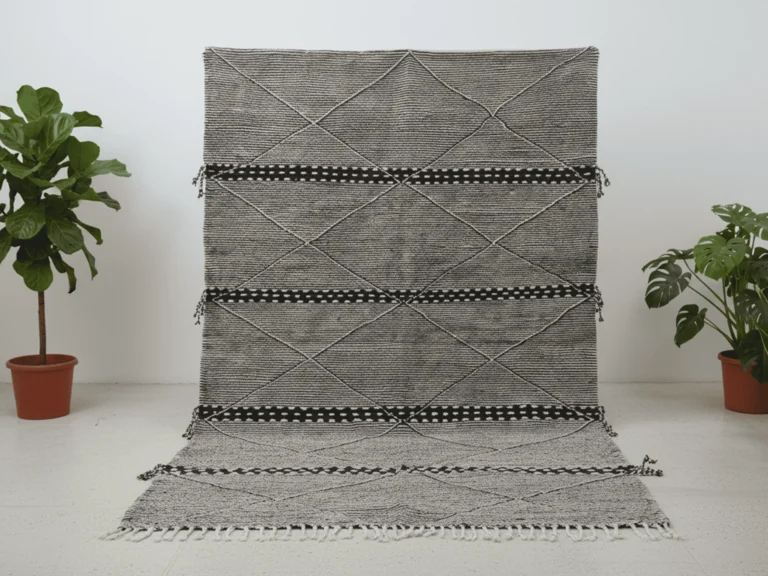
Two examples: our ivory rug with black symbols sets small hourglasses, chevrons and zigzags around a central chain of diamonds, and our round ivory and taupe symbols rug has stars, arrows and a little doorway drawn in a free, personal hand. Because every rug is handwoven to order, the symbols on yours will be placed by hand and will not match the photos exactly. To check that a rug is truly handwoven, see how to tell a handmade Moroccan rug from a machine-made copy.
Choosing a rug with symbols
- Choose with your eyes first. Pick the rug you like looking at. A story you cannot verify is a weak reason to buy, and a strong design is a good one.
- Match the density to the room. An ivory field with a few black marks, like most of our black and white Moroccan rugs, stays calm under a busy sofa and shelves. A rug covered edge to edge in colored bands works best with plain furniture. Our guide to styling a colorful Moroccan rug goes further.
- Think about scale. Small symbols get lost in a large room seen from far away. In a big living room, larger diamonds or bands read better. Our living room rug size guide helps you pick the size first.
- Ask where a meaning comes from. If a seller gives each symbol a precise meaning, ask for the source. A museum, a book or the weaver herself is an answer. “Everyone knows” is not.
- Want specific symbols? A custom rug lets you choose the design, colors, symbols and shape. See what to know before ordering a custom Moroccan rug or our custom rugs page.
On price: a 5 by 8 foot rug from our TAZRIRT Signature Collection, where most of our symbol rugs are, costs $2,070, and a 5 by 8 foot Beni Ourain style rug costs $914, with shipping, duties and taxes included. A rug that size takes about 3 weeks to weave. See all 5 by 8 foot Moroccan rugs, or read how much a handmade Moroccan rug costs for every size.
Rugs with woven symbols
 Signature CollectionIvory with Black Symbols & Striped BorderMade to order in your size
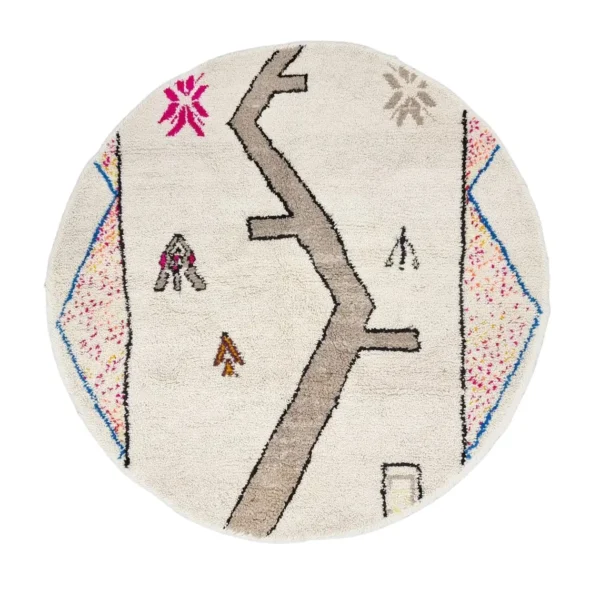 Round rugIvory & Taupe SymbolsMade to order in your size
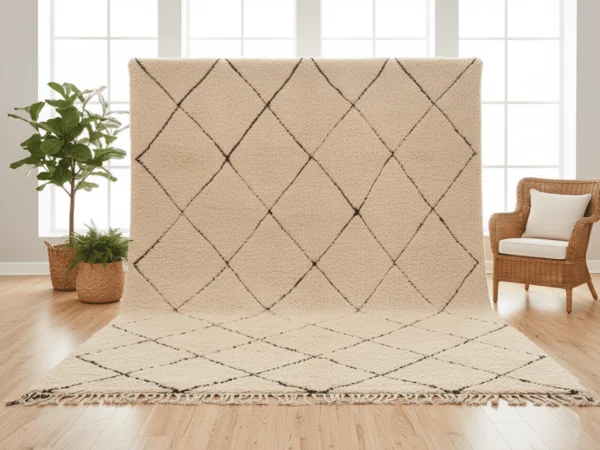 Beni Ourain styleCream & Black Diamond GridMade to order in your size
 Signature CollectionRed & Ivory Diamond Bands with Star BorderMade to order in your size
The short version
The diamonds, zigzags and hands on Moroccan rugs are real parts of an old Amazigh visual language shared with tattoos, jewelry and doors, and protection is the meaning best supported by museum sources. Beyond that, meanings change from place to place, and tidy symbol dictionaries are mostly guesswork. Choose the rug whose shapes you love, and treat any story you are told as a story unless it comes with a source. Compare the two best-known styles in Beni Ourain vs. Boujaad rugs, or browse all Moroccan rugs.
Sources: Peabody Museum of Archaeology and Ethnology, Harvard University, Imazighen: Amazigh Aesthetics and Symbology; Mucem, Amazighes: Cycles, Ornaments, Patterns (2025).