How to Layer Rugs: Sizes, Pairings and Keeping Them Flat
To layer rugs, put a large, flat, quiet rug underneath and a smaller rug with more pile, pattern or color on top. Leave about 20 in to 3 ft (50 to 100 cm) of the base rug showing on every side, so the eye reads two rugs and not one rug that is too small. Never stack two thick pile rugs, and use a non-slip pad under the base so the whole stack stays put. A 5 by 8 foot Moroccan wool rug on a 9 by 12 foot flatweave or jute rug is the classic pairing.
Below: why layering works, which sizes go together, which rug goes on the bottom, how to pair colors and patterns, and how to stop the top rug from slipping.
Why layer rugs at all
- A small rug in a big room. A rug you love may be too small for the room. A large plain rug underneath makes the zone the right size and keeps the smaller rug as the centerpiece.
- Texture. A deep wool pile on a flat, woven base gives the floor two textures, which feels warm without adding more pattern to the room.
- Budget. A large handwoven pile rug costs more than a small one. A plain jute base is usually inexpensive, so a jute base with a smaller wool rug on top can cover the same floor for less.
- Carpet. On wall-to-wall carpet, a rug on top marks a seating area or adds color the carpet does not have.
Sizes that work together
Designers usually leave 50 to 100 cm, about 20 in to 3 ft, of the base rug showing on each side of the top rug. Less than that and the two rugs blur together. The base itself should still be the right size for the furniture: at least under the front legs of the sofa and chairs.
| Base rug | Top rug | Base showing on each side | Result |
|---|---|---|---|
| 8 by 10 ft | 5 by 8 ft | 18 in at the sides, 12 in at the ends | Tight. Works in a small room, but the layers read less clearly. |
| 9 by 12 ft | 6 by 9 ft | 18 in all around | Even frame, calm look. |
| 9 by 12 ft | 5 by 8 ft | 2 ft all around | The classic pairing. Clear layers in most living rooms. |
| 10 by 14 ft | 6 by 9 ft | 2 ft at the sides, 2 ft 6 in at the ends | Generous frame for a large room. |
| 12 by 15 ft | 8 by 10 ft | 2 ft at the sides, 2 ft 6 in at the ends | Open-plan rooms and big seating groups. |
Not sure which base size your room needs? Start with our living room rug size guide, then pick the top rug from the table. Every TAZRIRT rug is made to order in the width and length you enter, so the top rug can be any size between these, down to the inch. The standard rug sizes chart lists all the common sizes in feet and centimeters.
Which rug goes on the bottom
- Flat and low. The base should be a flatweave, a kilim or a natural fiber rug such as jute or sisal. A flat base lets the top rug lie flat. Two thick pile rugs on top of each other wobble, slide and never sit flat.
- Quiet. Plain, natural or softly striped bases let the top rug lead. Sand, natural and soft gray all work.
- Large. The base sets the size of the zone, so buy it to fit the furniture, as you would a single rug.
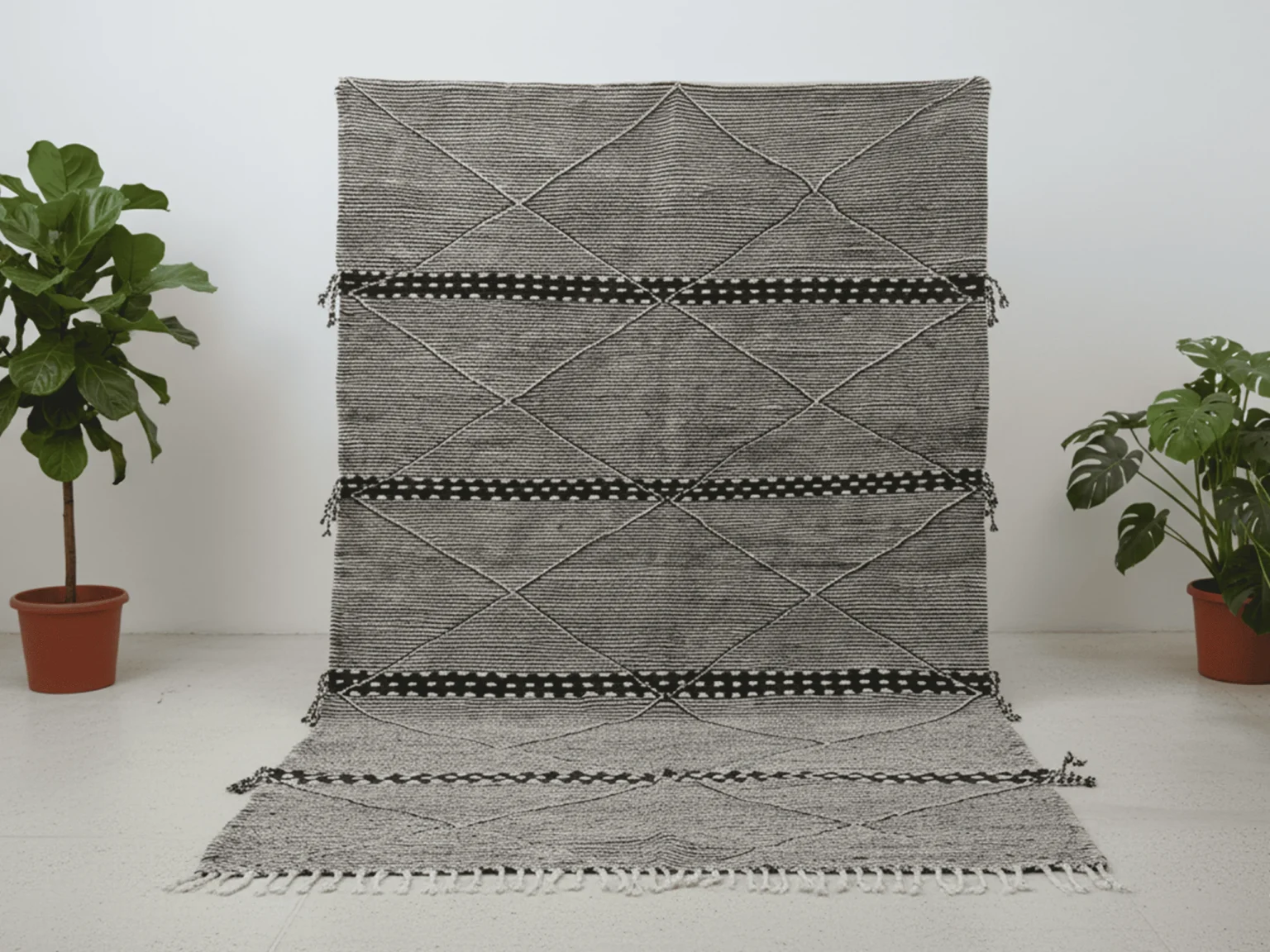
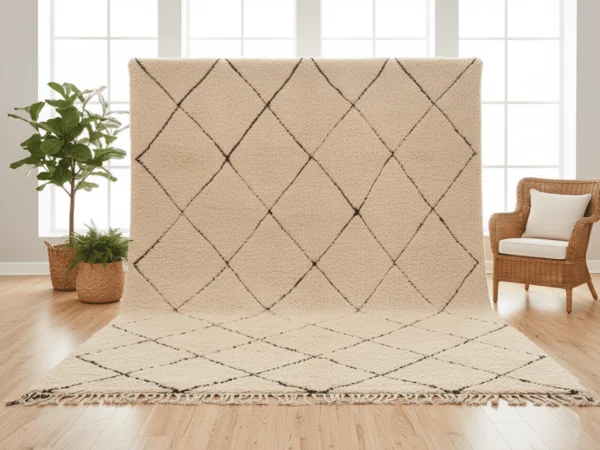
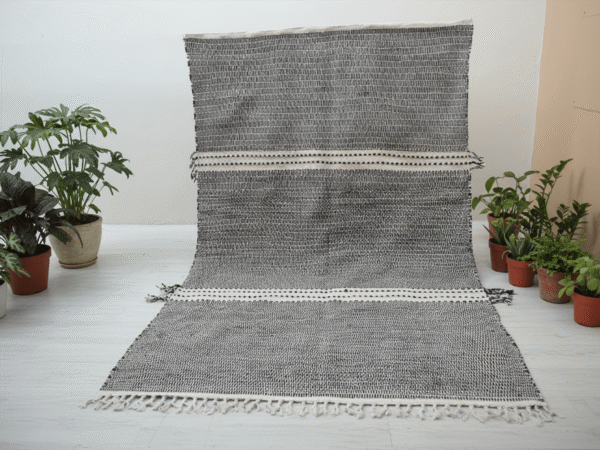
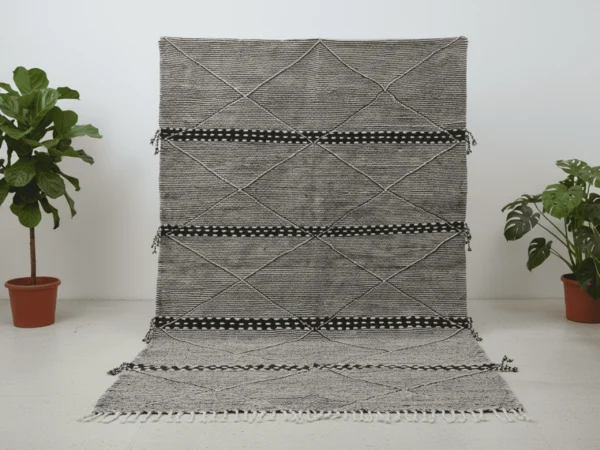
We do not sell jute rugs. If you want a jute base, a plain one from a local store is fine. If you would rather have wool all the way down, a Zanafi kilim is a handwoven wool flatweave that makes a thin, firm base, and a thick Beni Ourain style rug sits well on top of it.
Pairing colors and patterns
- One bold, one quiet. The simplest rule: a patterned or colorful rug on a plain base. A Boujaad rug in red or green on natural jute is a good example.
- Same family, different texture. For a calm room, keep both rugs in one color family, such as a cream Beni Ourain style rug on a sand or ivory base, and let the difference in pile do the work.
- Two patterns, one shared color. If both rugs are patterned, make sure they share a color, and keep one pattern larger than the other. A black and white flatweave under a cream rug with fine black lines is an easy match.
- Dark under light, or light under dark. Contrast between the two layers makes the frame visible from across the room.
More on choosing colors in our guide to styling a colorful Moroccan rug.
Straight, angled or off center
- Centered and square. The top rug sits in the middle of the base, edges parallel. Tidy and easy to live with.
- Angled. The top rug is turned about 30 to 45 degrees. This loosens a formal room and works well with a single piece of furniture on top, such as a chair or a coffee table.
- Off center. The top rug moves toward a focal point, such as a fireplace or a reading chair. It has to look chosen, so move it clearly, not by a few inches.
Keeping the layers flat and in place
- Pad under the base. Put a non-slip rug pad between the floor and the base rug. That holds the whole stack. Our guide to rug pads for wool rugs explains which pad suits which floor.
- Grip between the layers. If the top rug creeps, add a thin gripper pad between the two rugs. Keep it thin, or the top rug will sit too high.
- Furniture on top. A coffee table or the front legs of a sofa on the top rug hold it in place better than any pad.
- Check the edges. Two layers raise the edge of the top rug. Keep that edge out of doorways and main walkways.
Layering a rug on carpet
On wall-to-wall carpet the carpet is your base. On plush or high-pile carpet, choose a low-pile or flatweave rug, such as a Zanafi kilim. On low or flat carpet, a thicker pile rug adds warmth. Pick a color that clearly differs from the carpet, and use a pad made for rugs on carpet so the rug does not bunch or shift.
What a layered pairing costs
As an example, a 5 by 8 foot Beni Ourain style rug costs $914, and a 6 by 9 foot one $1,159. A 9 by 12 foot Zanafi flatweave as a wool base costs $2,288. Shipping, duties and taxes are included. A 5 by 8 foot rug takes about 3 weeks to weave and a 9 by 12 foot rug about 7 weeks. See all 5 by 8 foot Moroccan rugs and 9 by 12 foot Moroccan rugs, or read how much a handmade Moroccan rug costs.
Rugs for layering

The short version
Flat and quiet at the bottom, soft and characterful on top. Leave about 2 ft of the base showing on each side, which makes a 9 by 12 base and a 5 by 8 top the easiest pairing. Never stack two thick pile rugs, pad the base, and let furniture hold the top rug in place. Browse all Moroccan rugs, or ask us on WhatsApp for help with sizes.