What Is an Arabic Majlis? History, Layout and Modern Use
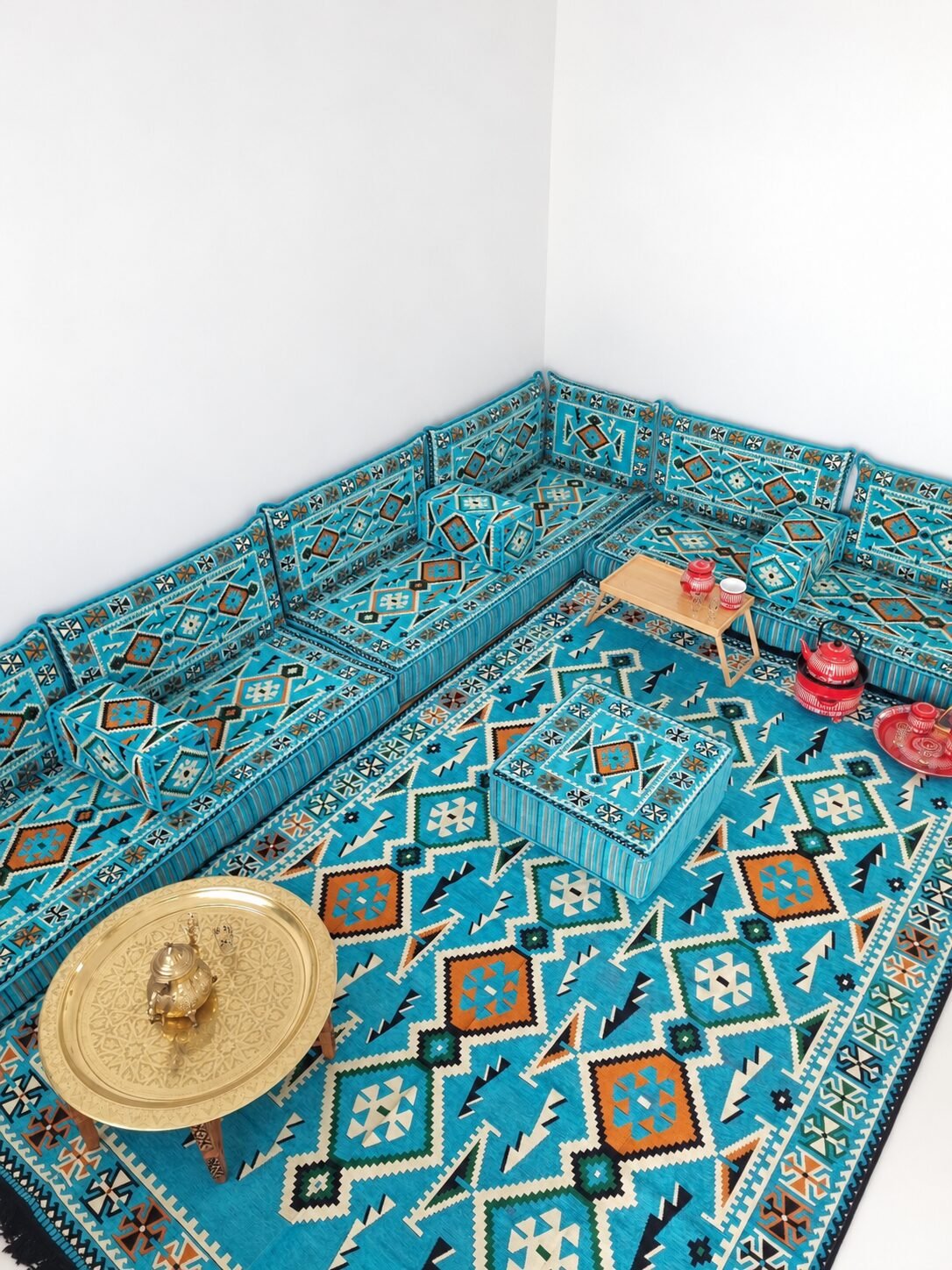
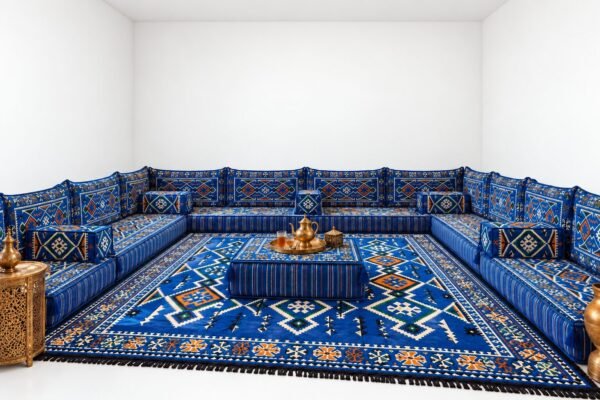
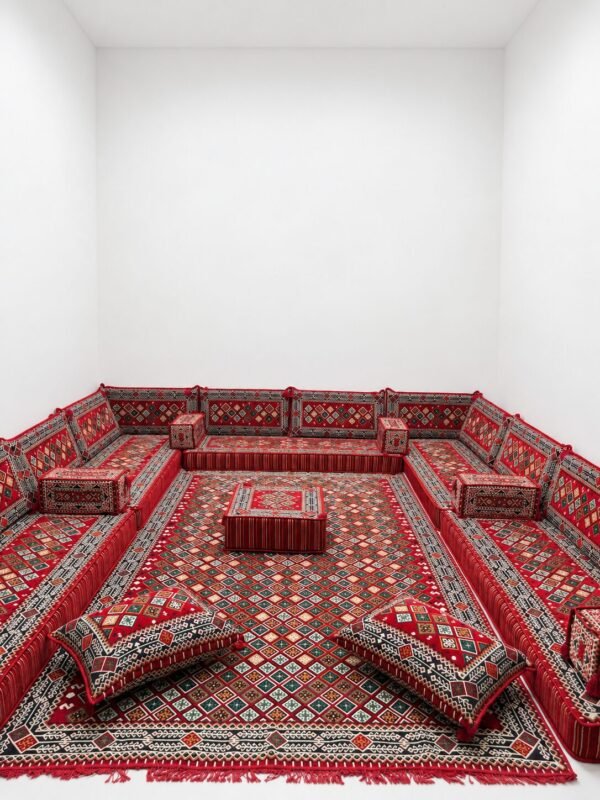
An Arabic majlis is a room, or part of a room, where people sit together on low cushioned seating that runs along the walls, all facing an open center. The word comes from the Arabic verb jalasa, “to sit,” and a majlis is literally “a place of sitting.” For centuries it has been where families receive guests, share tea and coffee, settle questions and simply spend the evening together. Today it is also a way to furnish a living room in an American home: an Arabic majlis floor sofa that turns any room into a place made for hospitality.
What the word majlis means
In everyday Arabic, a majlis can mean three things at once: the room where guests are received, the seating in that room, and the gathering itself. You can say you are going “to the majlis” of a family, meaning their reception room, or that a majlis was held, meaning people met to talk. The same root gives words for sitting and for a session, which tells you what matters most in this space: not the furniture, but the people who sit on it together.
In the United States the seating is sold under several names. You will see it called an Arabic majlis, an Arabic floor sofa, a majlis floor sofa, a floor couch or a floor seating set. They describe the same idea: long, low seats placed against the walls, with back cushions and armrests, instead of a raised sofa and armchairs.
A short history of the majlis
The majlis grew out of desert and village life across the Arabian Peninsula and North Africa, where hospitality was a duty and a matter of honor. A guest who arrived at a tent or a house was invited to sit, offered coffee or tea, and welcomed without questions. Seating on the floor along the walls made sense: it used the whole space, it could be moved, and it placed host and guests at the same height.
Over time the majlis became more than a sitting room. In the Gulf it was, and still is, a place where community members meet, where news is shared, where disputes are discussed and where young people learn by listening to their elders. In 2015 UNESCO inscribed “Majlis, a cultural and social space” on its Representative List of the Intangible Cultural Heritage of Humanity, in a joint file from the United Arab Emirates, Saudi Arabia, Oman and Qatar (UNESCO). The listing describes it as a space for gatherings, hospitality and the passing on of oral heritage.
In the Sahrawi tradition of southern Morocco, the majlis lives first in the tent, the khaima, and then in the house. The seats are low and deep, covered in heavy patterned textiles, and the center of the room belongs to the tea tray. Tea is poured three times, slowly, and the conversation follows the rhythm of the glasses. That is the tradition TAZRIRT comes from, and the one our majlis sets follow.
How a majlis is laid out
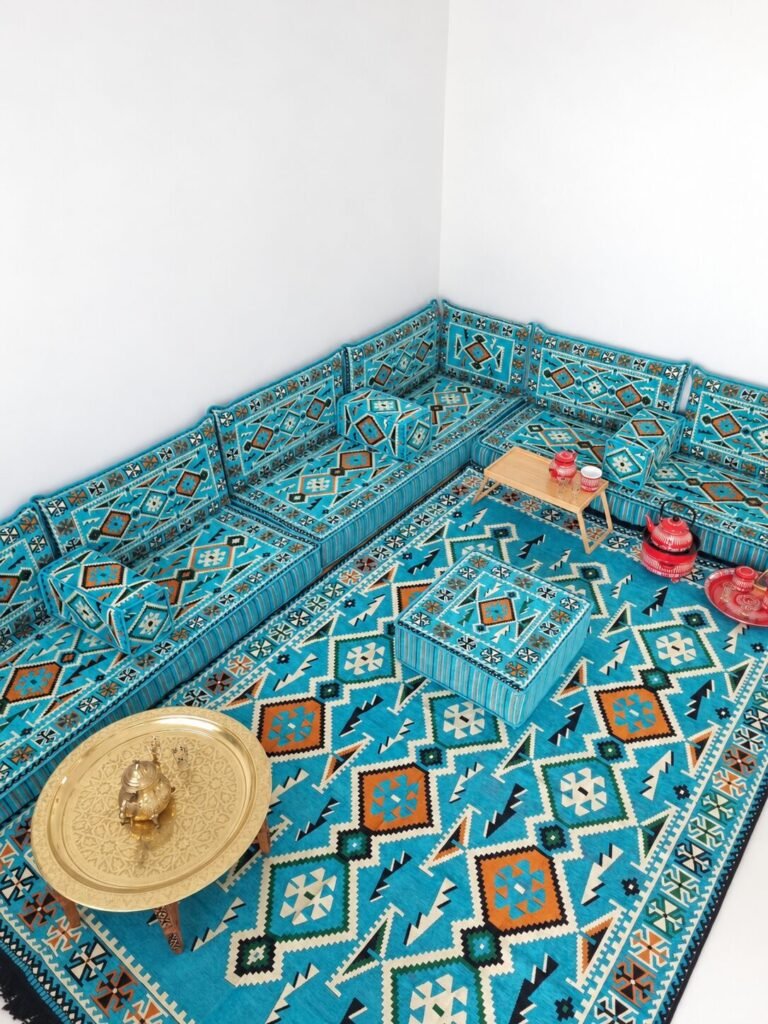
Every majlis follows the same simple rule: seating around the edges, open floor in the middle. The pieces are few.
- Seat mattresses. Long cushions laid on the floor against the wall. At TAZRIRT they are 15 cm (6 in) high and 70 cm (27.5 in) deep.
- Back cushions. Stood against the wall behind the seats, so you can lean back as on a sofa.
- Armrest bolsters. Placed at the ends and between seats, to close the line and give an elbow rest.
- The center. A rug, a low table or a brass tray table, and often a few poufs or floor cushions that can join the circle when more guests arrive.
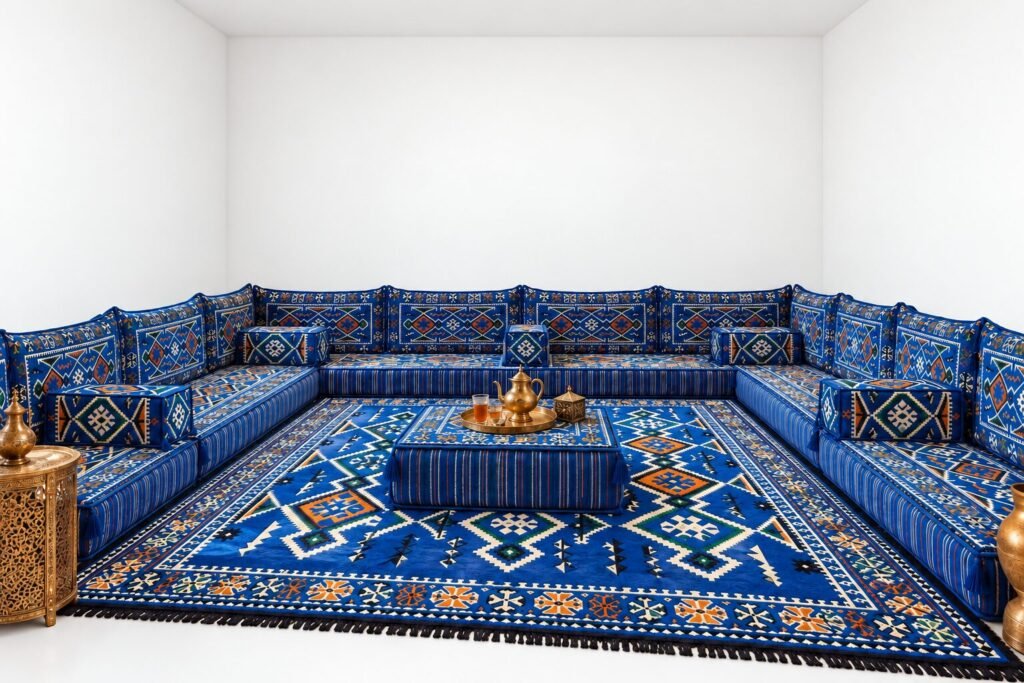
The seats can follow one wall, two walls in an L, three walls in a U, or the whole room, broken only by the door. The U is the classic shape: everyone faces the center, and the open side leads to the entrance. Our guide to planning Moroccan floor seating explains each layout in detail, with the measurements to take.
Majlis, diwan and floor sofa: what is the difference?
The names overlap, and that is normal: the idea traveled across many countries and languages.
| Name | Where you hear it | What it usually means |
|---|---|---|
| Majlis | Arabic-speaking countries, the Gulf, North Africa | The reception room, its low seating, and the gathering held in it |
| Diwan | Across the Middle East, and in English as “divan” | A long low seat or a reception room; in English, a low sofa without a back |
| Arabic floor sofa | US and European shops | Majlis seating sold as furniture: seats, back cushions and armrests |
| Floor couch, floor seating set | US shops | Any low seating on the floor, from simple cushions to full majlis sets |
How it feels to have a majlis at home
A sofa faces a screen. A majlis faces people. That one difference changes the whole evening. When guests arrive, they take off their shoes, choose a place along the wall and settle in. Nobody sits at the end of the row, outside the conversation. Children sit between the adults. Tea is poured in the middle, and the night slows down.
It is also a room that very few homes have. Guests stop at the door the first time they see it: the color running around the walls, the cushions lined up, the open floor in the center. Then they sit, and they do not want to get up. What a majlis adds to a house is not only seating. It is warmth, beauty and the feeling of being received, which is the oldest meaning of the word.
The majlis in a modern American home
You do not need a palace or a dedicated reception wing. In the US, a majlis usually finds its place in one of these ways:
- As the main living room. An L or U shape replaces the sofa and armchairs, with a low table in the middle.
- As a second living room or guest room. A room kept for receiving family and friends, for holidays, Ramadan evenings and Eid visits.
- As a reading or family corner. A single straight wall of seating, where children play on the rug and adults lean back with a book.
- In a basement or bonus room. Low seating suits rooms with lower ceilings and makes a large space feel gathered.
A white or light wall makes a patterned majlis the center of attention. Low lamps or lanterns keep the light at seated height. And a rug that fills the open center ties the room together; our living room rug size guide shows how to size it.
Floor seating is not for everyone, and it is better to say so. Getting up from 6 in is harder than from a sofa. If someone in your home has stiff knees, a few regular chairs in the room, or a raised base, are worth planning for.
What a TAZRIRT majlis is made of
Many majlis sets look alike in photos and are very different once they arrive. Here is exactly what ours are.
- The fabric. We do not weave it ourselves. We buy a rare, heavy Sahrawi textile that reaches our workshop already woven, about 3 mm thick and around 750 g per m², much heavier than light printed copies. We then cut and sew every piece to the measurements of your walls.
- The foam. Dolidol foam with its five quality stamps and a 25-year guarantee. You choose soft (“XD + ABS 33”) or firm (“XD”).
- The covers. Removable and washable, which matters in a room where tea is served every day.
- The timing. Made to order in 10 to 15 days, then shipped. Shipping within the US is free.
Each seat set, made to order, includes a seat mattress, its armrest and two back cushions, from $1,230.
Arabic majlis floor sofas at TAZRIRT
How to choose your first majlis
- Pick the room and the walls. Decide which walls will be seated and where the door is.
- Measure each wall at floor level, corner to corner. Each seated wall takes 70 cm (27.5 in) of floor depth.
- Choose the layout. Straight, L, U or full room, keeping enough open floor in the middle to walk around a table.
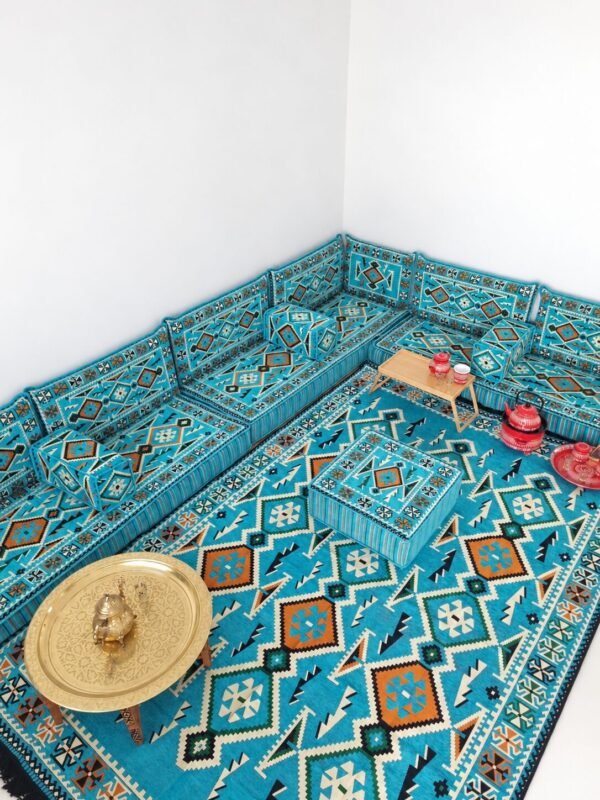
- Choose the fabric. Reds such as Anzaran Royal Red are the most traditional and the warmest at night. Greens like Tawarta Emerald Green feel calm. Lighter tones like Tiris Sand Beige suit a bright, modern room.
- Design it online. In our majlis designer you type the length of each wall, and it fills the walls with the fewest pieces, shows the plan and a 3D view, and gives the price.
Frequently asked questions
Is a majlis the same as a sofa?
No. A sofa is a raised seat for two or three people. A majlis is continuous low seating around a room, built so that everyone faces the center and the conversation stays in one circle.
Can a majlis fit in a small room?
Yes. A straight or L-shaped majlis often seats more people than a sofa in the same space, because there are no bulky arms and no gaps between pieces.
Is a majlis only for Arab or Muslim homes?
Not at all. It is a tradition of hospitality, and anyone who loves having people over can enjoy it. Many homes simply use it as the most welcoming room in the house.
Ready to see one on your own walls? Explore the full Arabic majlis floor sofa collection, or start in the designer.